

What Are Shocks And Why Are They Important?
Shocks are an instrumental part of a vehicle’s suspension system. Also called shock absorbers, shocks isolate the car body from the motion of the suspension system. One end of the shock connects to a component of the suspension system, usually the control arm. The other end connects to the frame or body.
Why Does Your Vehicle Have Shocks?
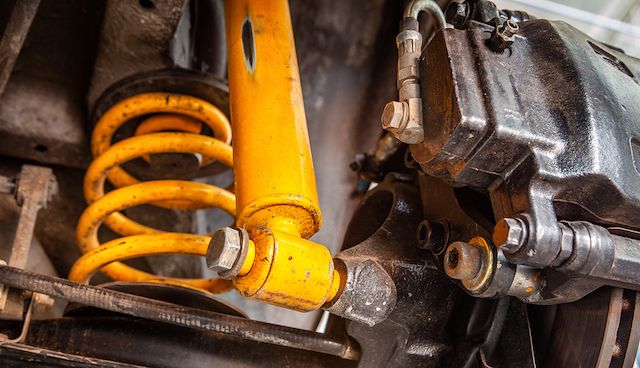
If you look behind a wheel on your vehicle, you’ll find a shock (if not a strut – more on this later). It’s important for your vehicle to have functioning shocks. It’s because:
- Shocks help keep the tires firmly planted on the road.
- Shocks maintain your car’s ride quality.
- Shocks stabilize your car's movements when you brake, accelerate, or turn a corner.
Without shocks, you'll experience poor ride quality. To be more specific, your car would be bouncing all over the place. Shocks enhance your safety and ride quality on the road.
What Does A Shock Look Like?
A shock is a long tube-shaped part. The dimensions depend on your vehicle. The average shock is between 15 inches and 20 inches when extended. The top and bottom parts of the shock contain mounting points. A hydraulic tube takes up the center of the shock.
The Components Of A Shock
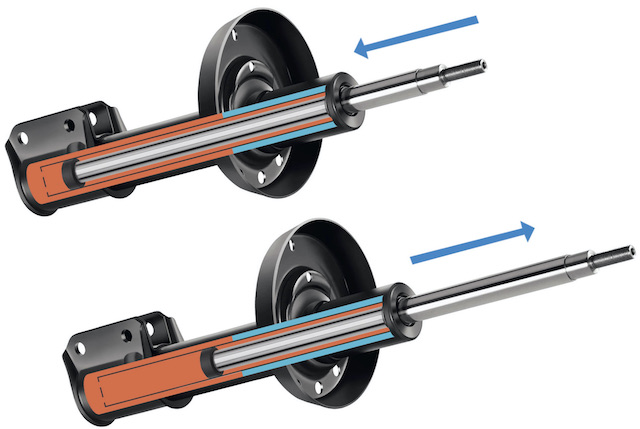
A shock absorber looks like a simple part, but it contains many important components:
- Upper mount
- Lower mount
- Bushing
- Shield
- Seal
- Piston rod
- Outer tube
- Upper chamber
- Piston
- Piston valve
- Lower chamber
- Inner tube
- Hydraulic fluid reservoir
- Check valve
Each component serves an important role in the inner workings of a shock.
How Does A Shock Work?
A shock absorbs the impact from the road. With a set of good shocks on your vehicle, you won't feel most of the bumps or dips on the road. You also will experience better ride quality while braking, accelerating, and turning corners.
Your car also has a set of springs. The reason for that that springs support the weight of your vehicle, while also allowing the suspension or axle to move up and down. Your car needs springs and shocks because if it's operating with just springs, your car would be quite bouncy. Shocks "smooth" out the force caused by springs by limiting spring oscillations. The hydraulic fluid inside a shock causes resistance when the shock compresses or extends. This reduces or eliminates the bounciness that happens when your vehicle hits a bump or dip.
Somewhere between 50K-100K miles, most shocks wear out. Your shocks’ longevity depends on the roads you drive on. If you regularly drive on bumpy roads, your shocks will wear out faster.
If you need to replace your shocks, we can help you save money. We sell genuine OEM parts at wholesale prices. Our inventory contains OEM parts for a wide variety of makes and models. To find the right OEM shocks for your vehicle, look up your make and model here.
Are Shocks The Same As Struts?
A vehicle has one of the following setups:
- Shocks on all four wheels
- Struts on all four wheels
- Shocks on one axle, and struts on the other axle
Shocks and struts are not interchangeable. They are different parts. This post explains the main differences between both parts. The primary difference is that a shock just absorbs motion, and a strut is a combination of a spring and shock.